 F-Bomb Alert: My mom should not read this post (she will anyway).
My teaching career is officially, finally, and irrevocably over. After 19 years in the biz, I've had enough. A few months ago, a friend of mine said, "You know, there are problems at every job; I just need a different set of problems." And I guess I kind of took her statement into my own heart.
The more I thought about it, the more I realized I, too, need a different set of problems. So I went out of business...mainly because I'm too tired to keep the store open anymore and because I'm not even sure how I went from being a teaching professional to a business owner.
"Delivering composition." It's the title of a well-known book in my former field, and it's the way many in that field refer to their work. Deliver stuff to someone. Like fucking UPS. It's the tabula rasa in make-up and high heels (because those who "deliver composition" are overwhelmingly female). Worse still, while every college and university across the nation considers composition a foundation of their educational program, it is largely taught by contingent faculty...mostly women...who are far too generous with their time in comparison to the pay they receive, which is among the lowest at any university. Darkness visible: importance undervalued.
I didn't actually sign up for a teaching career. Like most things in my life, it fell into my lap. My Pell Grant was suddenly cut off, and I was forced to graduate. I spent a summer wondering, "What the hell?" And then I got a call from a college friend. The Intensive English Program needed a warm body to stand in front of a class of international students. "Could you be that body?" I was desperate, so I took the job. I remember buying cheap "professional" clothes from Wal-Mart after I accepted my offer. They (the clothes, not the offer) were (a) too big and (b) so unfashionable even for the time that, if you tagged me in a picture of myself wearing them on Facebook, I'd have to unfriend and then block you (after untagging myself, of course).
The funny thing is no one in my new department wanted to teach writing. Being the n00b, I eventually became the expert in teaching writing to students for whom English was a second language...through experience and gut instinct...not through any sort of training. Sure, I read some articles, tried some stuff, and eventually disposed of it because it didn't really get at the reality of how people learn to write well.
You know, I've been writing since before I could write. I'd pen stories I spoke out loud as I wrote down chicken scratches that I thought looked something like the alphabet. I'd show them to my mother: "Sansy, you'll learn to write soon enough." She was wrong. In first grade, I was not taught to write. I was taught to copy. I was also taught that variation from the norm is forbidden. This set of rules for behavior was known as "penmanship," and it taught me that words ending in -ship are often not trustworthy: hardship, censorship, partisanship (not a real thing), membership (generally leads to responsibilities one does not want), kinship (backstabbing, in-fighting, general carnage), etc. So I took to my granddad's typewriter (a Remington that celebrated it's 92nd birthday in July) and did my own thing sans a fat pencil, a Big Chief tablet, or a template. (I'm going all Lady Gaga and seeing how many times I can work my own nickname into each post. See?). It also taught me that if you really want to learn to do something, you have to take matters into your own hands. That's how I learned to actually write, and it didn't feel soon enough. Even at that young age, I had something to say, I wanted to say it, and I felt like forces were holding me back.
My mom and I discovered, when I was in high school, that the reason I was never assigned homework is because I actually was. I just didn't understand the concept. The teacher would tell the class to read this and fill out that, so I did it when I was bored and waiting for everyone else to catch up with whatever the teacher was droning on about (which I had already read in the textbook). I thought that was what we were supposed to do...keep busy. I didn't know I was supposed to sit there quietly doing nothing while all that homework piled up for us to take home.
My bad.
At least I had glorious afternoons playing in the weird back yard that was designed by a concrete manufacturer in 1884: a reflection pool, a rock garden, an octagonal fish pond with island and bridge, a six-foot high bird bath, a wisteria arbor. Hell, the man even encircled the clothesline with sidewalk. My house was THE place to be after school. And when everyone got called in for supper and I had finished eating, I went to the typewriter.
One day, in fifth grade, I ran out of homework to not take home. So I wrote a poem about what was going on in the classroom. I observed things I had never noticed before; it made me pay attention (I even made it rhyme, and, yeah, I know, "E Gad!"). I copied it, by hand (I didn't have access to the lovely pasty smell of the ditto machine) and gave it to my teacher as a sort of present. She gave it to the school secretary, and thus I became a published author for the first time...in the school newsletter. Later that year, I was given an assignment to write a biography about someone famous (good grief, why do these subjects withstand the test of time?). I naturally wrote an essay about one of my ancestors, Benjamin Franklin, whom my dad was named after, and I got the highest grade of anyone for that assignment. I was only interested in my subject because my dad had studied Ben's life backwards and forwards, in all its tarnished glory, and had regaled me with the more kid-friendly of our progenitor's exploits. After I had written the paper, I asked my dad to check it. I don't know if he was laughing at my naivete or with joy that he had taught me something. Probably both. At any rate, he kindly and verbally corrected some parts and told me how proud he was of me. Through so many experiences like these, I learned the power of observation and that I was a WRITER.
If you want to write well, here's what you need to know:
- If you want to write, just do it.
- No matter how bad it's going, wait for the moment when it all turns right. It'll happen.
- It doesn't hurt to share. Some will love you; others will rip you apart. Somewhere in the middle is the truth.
- Motivation is key; you need to want something bigger than yourself and your own little world.
- You'll mess up a lot (typewriters are good for reminding you of this).
- Find a way in to every project.
- It isn't cheating if you ask for help.
There, I bubble-wrapped it, put it in a cardboard box filled with Styrofoam peanuts, taped up the box, drove it to your house, knocked on your door, and handed it to you. Delivered.
There are several problems with this metaphor, however. Once something has been delivered, what happens to it?
- What if the customer doesn't like it and wants to return it? (I thought I wanted Product X, but I've changed my mind.)
- What if the customer wants an exchange? (I want a better version of Product X.)
- What if he/she never opens the box (In one week, I'm no longer interested in Product X. In fact, I'm so uninterested by Product X, I won't even take the time to open the box or inquire about a possible return. I'm actually willing to lose money on it by not returning it.)
- What if your consumer only consumes part way and gives up in frustration? (I can't understand the instructions; I'll just leave it in the garage half done.)
- What if the product is a "gift" the consumer didn't want?
- What if the product doesn't meet the customers expectations because they didn't understand the product's description? (Wait, I bought a hardware key logger so I wouldn't lose all my stuff in the event of the Zombie Uprising, and you're telling me I can't use it with a laptop?)
Begin digression. 4 That last one was oddly specific, wasn't it? 3End digression.
There are a number of problems with this metaphor. The first of which is that students are not consumers and teaching does not result in a product. Consumers are people who buy, let's be literal, food and eat it. I don't want the "products" of their consumption landing on my desk. And maybe that's why student writing is so often crappy...because we've adopted the wrong metaphors for understanding what writing actually is and we refuse to see that learning how to do it will be different for every single person. No method is prêt-à-porter. Also, you can't deliver learning and expect anything to happen. You have to create opportunities for people to learn, and the classroom is probably the worst place for opportunity with its hierarchy so obviously laid out in rows.
To make matters worse, if I were still in the delivery business, as a member of the contingent faculty, I would have the additional threat of being drawn and quartered hanging over my already taut nerves. The Four Horses of the Apocalypse who would ensure the failure of my delivery would be as follows:
- My creditor: the person who renews my contract, i.e. my chair.
- My landlord: the state that pays me.
- My competition: the other composition programs out there who drive every program to act according to the same model.
- My customers: the people I'm supposed to serve out of the goodness of my heart.
Let me break it down. My creditor wants me to maintain standards, which means certain grades should form a bell-shaped curve. (The books must be balanced!) My landlord wants me to concentrate on retention which means I should do whatever it takes to make sure students pass my class. (You must pass all regulatory inspections.) My competition wants me to stay within the accepted rules of how we deliver our goods; this doesn't affect me personally, but it certainly dictates the methods by which we assess our program. (We are the standard-setters for this particular business; never mind your unique circumstances. Our guidelines should be met by everyone.) And finally, there are the customers. The people I'm supposed to serve out of love for teaching. And if I could have gotten loose of my restraints, believe me, I would have made my getaway on their horse. Unfortunately, there's already a master holding the bridles, and that master's name is "Lottery College Scholarship."
These students have been told they stand a fighting chance, and they want it. We tell them that writing is about exploration, and they feel invited. And then we slap a grade on their fledgling attempts, and I'm sorry for the mixed metaphor (but, hell, I'm the queen of the mixed metaphor and there are so many in this text already, what's one more?), we expect them to fly?
This model is broken because it pits the teacher against everyone else.
Students want to maintain their scholarships; chairs want a bell-shaped curve. The legislature wants to move the college graduation rate above 18%. I'm not sure standards have ever actually entered the minds of any legislator in this respect. My imaginary elected official thinks something like this: "Give college students the Easy A, damn it! Knowledge-based industries like Google will never figure out how woefully inadequate our workers are until we've attracted them with our tax incentive packages, and then it'll be too late!" Beg your pardon, legislators, the information age is actively looking for brain capital, and they know we don't have it.
In the meantime, the Council of Writing Program Administrators (WPA) sets standards for class size and assessment guidelines that go against anything any administrator in this state has the money to agree to thanks to the legislature that subsidizes every public school of higher education here. This is the very same legislature that decided to award unprepared students scholarships for college with stipulations they can't meet.
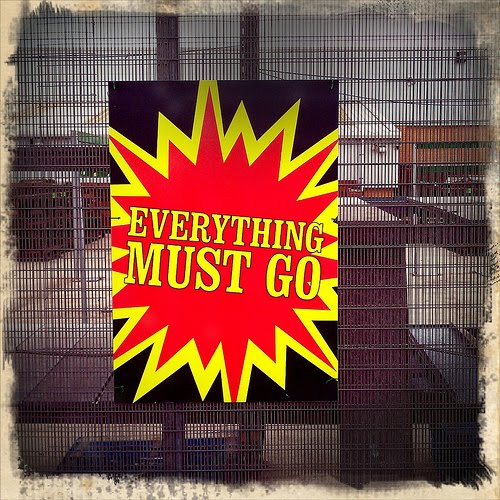
And this is why everything must go. And by everything I mean grades, standards, enforced curricula (assignments, textbooks, methods of teaching, especially the tabula rasa model), and the disenfranchisement of women in the discipline.
Oh, and grading 640 papers a semester? That was the first thing I put into the trash.
Photo Credit: Bearfaced via a Creative Commons Attribution-Noncommercial-NoDerivs License. http://www.flickr.com/photos/bearfaced/5845467008/sizes/m/in/photostream/

