Showing posts with label metaphors are our friends. Show all posts
Showing posts with label metaphors are our friends. Show all posts
Wednesday, December 19, 2012
Bad Romance: Part II
How to Sexually Harass a Woman (Or Anyone, Really) as Seen through the Lens of a Lady Gaga Video
If you've known me for any length of time, you are probably sick of hearing about Lady Gaga. I am a Monstrous Fan...for a number of reasons: she shares my lone superpower of wearing heels so high that we breathe clouds (not plain air like all you plebeians...I kid...mostly), she doesn't take herself very seriously (she falls down in those heels on stage all the time and gets up laughing), I find her songs imaginative, and, sue me, I love the added layers synthesizers can bring to a piece of music in the hands of the right musician. But I'm also a fan because of her videos, which are rich with complex meaning.
The video for "Bad Romance," however, has always stood out for me above all others, even "Born This Way," which is the video responsible for completing Lady Gaga's very own cosmology, another world that exists apart from the quotidian for the short bursts of time she performs live. There is something about "Bad Romance" that practically eviscerates me. After the news broke about my sexual Harasser being arrested for taking upskirt shots of women in a local big box chain, the first thing I did was watch videos of him taking videos in the store. Surreal.
Then, I watched "Bad Romance," and I realized what it is about the video that elicits such a visceral response, and it's the constantly shifting point of view. When the video begins, the person whom we call Lady Gaga is a sleeping queen on a throne—an example of "subjectness" although, a, perhaps, lax subjectness. In a plot twist, she touches a button on a console next to her (actually a Parrot by Stark speaker) and is shaken awake into a dream. The facts of this dream are what shock because as she morphs (the way I do when I'm dreaming) into the different people who populate the dream, she becomes a different example of the dark side of objectification (ending with the darkest of all). I realized that day, after seeing the news and subsequently watching "Bad Romance," that I was being shown a movie about my own existence. And this is where our instruction on sexually harassing a woman begins.
Step One: Kill Her
After pressing the button, the queen is projected into the Bath Haus of Gaga. Make no mistake: this is not a spa; it's a morgue. Gaga emerges from a sleek white coffin in the form of a ghost in white latex. In current popular culture ghosts possess two characteristics. First, watch any reality show that attempts to prove the existence of ghosts, and you will learn they don't speak. Second, they are beings whose ability to act upon the world is severely limited, if possible at all.
For the typical sexual harasser, who is a misogynist, to be successful at his project, he must first "kill" his victim, rendering her into a ghost-like figure. The guy at the table who talks over a woman trying to speak during committee meetings is a sexual harasser in the making if not one in fact. In my case, the harassment began discreetly the summer before the Harasser felt comfortable enough to make an open display of it. To recap, I was taking part in the professional development workshop that I would later help administrate. As part of that workshop we handed in pieces we had been working on that were in draft stage. I had asked that no feedback be given on my work. The Harasser's response was "Well, how are you going to improve if you don't receive any feedback."
True, but having taught writing for 17 years, I know there is a time when feedback is valuable and a time when it isn't, and the writer should be the one to decide when it's time. Additionally, verbal feedback is better because it tells the writer something about this one audience member's attitude, emotions, and frame of mind. Not only that, but I had a bad experience in graduate school with a male classmate who felt we were in competition and basically "ripped me a new one" in an attempt to eliminate me, and I still had that bad taste in my mouth.
So I asked, "Could you record your comments and send them to me?"
"No, that's not the way we do things."
When I got the comments back, I looked at the first page and threw the copy in the recycle bin. The feedback was not going to help me...and not because I planned to ignore it...but because the Harasser was responding to his idea of what the final product would be and not to what it was at the time, which was unfinished. I was becoming the ghost who doesn't speak or, rather, can't make herself heard.
The fatal wound occurred on the day I've described in "Bad Romance: Part I." Having given this a lot of thought over the last few months, I now understand that the harasser's ideal victim is the one who attempts to ignore the harassment, in other words, the ghost who does not or cannot act on the world. As I mentioned in Part I, this allows the harasser to fantasize that the victim is giving chase. In Lady Gaga's video for "Yoü and I," which is a retelling of the Pygmalion myth, she sings, "Something, something about the chase," and we all know the titillation of that game...those first few weeks of infatuation where the would-be lovers play tag like children. This is what the harasser seeks, except the chase isn't mutual, nor is it about infatuation, nor is it ultimately about the freedom to play and experience joy (a point I will come around to later).
There are other responses: I could have done as my friend advised and simply stood up, put my hand out, and said, "No." I could have reported it to his supervisor that afternoon. I could have "seen his 10 and raised him 20" by whispering, "Why is being married a problem?" And while my response was the worst possible because I allowed myself to be turned into a ghost thus giving him exactly what he wanted, none of the other responses really suffice. Saying "No" only sends him to some other victim. And I mean no offense to the director, who is still a good friend, but reporting it at that stage would have gotten him a slap on the wrist and me an apology of sorts: "I'm sorry; I really didn't mean anything by it." That's as far as any upper-level administrator could have legally gone. And reflecting his mirror image back to him may have made the situation worse, another point I'll return to later.
Step Two: Make Her into Your Own Image
In one short scene of "Bad Romance," Gaga is pictured standing in front of a mirror in a black dress, with that odd crown (this time in black) she's famous for, wearing black sunglasses. While singing "I want your drama, the touch of your hand, your leather-studded kiss in the sand," she reprises Madonna in her "Respect Yourself" parody of Michael Jackson grabbing his crotch. To me, this symbolizes the point at which, after having metaphorically killed his victim, the harasser must now make the shadow-self that is the object of his "affection" into his own hyper-sexualized image. In order to keep up the charade that the shadow-self is giving chase, she must want what he wants. It is also, of course, a way to justify actions he knows to be wrong. My Harasser has a wife and daughters; I'm 100% certain that if anyone did to them what he did to me, his reaction would have been similar to my husband's. But he felt no guilt because I was like him and, despite all evidence to the contrary, wanted what he wanted. However, this does not make me "one of the boys." In "Respect Yourself," Madonna is wearing pants when she grabs her crotch. In "Bad Romance" Gaga is wearing a dress, and I think this is intentional because she is not mocking a man in so much as she is questioning what happens when a woman in the garb of a woman makes the same gesture. In making the victim into his own image, the harasser does not confer male status onto the shadow-self, he makes her a slut...all the more worthy of harassing.
Step Three: Make Her Think She's Crazy
The scene of Lady Gaga in the insane asylum is so reminiscent of the bathtub scene in Valley of the Dolls that I'm convinced the director had it in mind. Tellingly, Gaga appears doll-like with curly pink hair and eyes disturbingly shaped like anime characters. She appears in a bathtub wearing earbuds and some sort of asylum-issued bath suit while being placated by the music she listens to like every stereotypical psychotic we've ever seen in a movie. She is unwillingly made to drink something by two nurses who force her mouth open and pour the elixir down her throat. Intermittently, the video flashes back to the ghost, and we hear the words "I want your love and all love is revenge; I want your love, and all your love is revenge." There are two psychical states being enacted here. The first is the deep anger a harasser feels over the lack of control over the "other" as evidenced by the lyrics, which switch point of view as often as the video, and the second is the age-old scheme of making the victim question whether what she believes to be happening is actually happening.
For the harasser, "love" is revenge.
I'm a technical writer and a rhetorician. It's my business to know the most efficient ways of communicating with people. So during the time I was working on the presentation submission form for the conference our organization was hosting, I often received e-mails from the Harasser about changes that needed to be made. Mostly, the changes took less than five minutes, so instead of initiating an unnecessary chain of e-mails, I took care of the problem immediately and assumed that, as happens with tech writers collaborating on a project, he was monitoring the document as the changes were being made, which I had shown him how to do. Instead, I got angry e-mails asking why I hadn't responded to his e-mails (which left me wondering why he hadn't just checked the document for the changes he asked for...as we had agreed). For him, this accomplished three goals: 1) it gave him further reasons to engage me, 2) it allowed him to assert authority over me (where he actually had none), and 3) it caused me to begin questioning whether the e-mails, which varied from sycophantic begging to acrimonious demands to obsequious apologies, were actually a form of sexual harassment. None of this behavior was described in the training I have to undergo every year as part of my position. My thought was "Maybe he is doing the best he can at his job and is truly stressed, and I'm the one being paranoid." Hell, he had me apologizing for things I didn't do wrong while dehumanizing me at the same time. His anger was a subterfuge designed to manipulate me into questioning my own sanity.
So when I saw two stills of him angrily stalking the aisles of the local big-box chain, I knew that the anger was part of the MO. Now, I don't know what he's angry about in those photos...maybe he's not finding a skirt-wearing victim quick enough for his satisfaction, maybe he and his wife got into an argument before he left for the store, maybe he's angry because he's disgusted by his own behavior. It doesn't matter, he's angry. And this brings me back to two points I promised to come back to earlier. First, his endeavor is devoid of joy. The way he approaches it, with that countenance of consternation, it's more like a job taken on strictly to make ends meet. Second, anyone who's angry is dangerous. I believe it was the b-movie The Seduction where Morgan Fairchild plays a newscaster who foils a rapist by returning his "advances." He later begins stalking her with vengeance in mind. And while that was fiction, the mind that objectifies others in "violent" ways (in my case the violence was purely emotional, but it was there) experiences an es muss sein, "this must be." He considers any alternative that does not put him in control a violence against his own psyche, and he will most likely carry out an act of retribution. Which is why returning the harasser's advances is not a good idea. He must be in control at all costs, and while he will generally walk the fine line between ignorance of wrong-doing and open transgression so as to get off the hook when called out, if the axis of his world goes off kilter, the power of that anger remains. Emotional violence can transmogrify into the physical.
There is no doubt that the man in the next scene of the video is the one responsible for sending Gaga 1) to the morgue, 2) to the mirror, and 3) to the asylum. Once this is a fait accompli, there is only one step left.
Step Four: Possess Her
I only want to touch on a few scenes in the final sequence of events in "Bad Romance." Lady Gaga is brought out against her will before a king who quite possibly now occupies her former throne and is made to dance for and then crawl to him for his pleasure. She is later shown frozen, as an object, in the middle of a circle of seated men as stocks in Lady Gaga, as a corporation and not a real person, continue to rise. We see her naked in a cage with monstrously huge vertebrae that force her spine to curve grotesquely. She has fulfilled the darkest stage of objectification possible: she has become a possession, a bauble, a sideshow freak, a slave.
This is ultimately what a sexual harasser, a child molester, a peeping tom, a rapist wants: to claim ownership of another human being because that is the ultimate source of power for him. I'm no psychologist, so I can't identify where their sense of self got stuck or what may have caused this to happen. I just know they have issues with power and control, which they can only regain by dominating those they consider weak.
In the end, Gaga tricks the new king and sets him on fire, Farrah Fawcett style, while he sits on his bed as she pretends she is about to perform for him and him alone.
Lucky her.
The article on "Sexual Harassment" at Wikipedia discusses how victims have coped in the past by taking on the personae of "the lady," "the flirt," and "the tomboy." The message is that we, as women, cannot be ourselves when being victimized by a harasser. It goes on to give the common side effects of sexual harassment, which include the following: stress, humiliation, being the subject of public scrutiny, decreased productivity, loss of support, etc. All of this says to me that I bear the burden for seeking counseling for and rectifying what was done to me. No mention is made of what someone who commits sexual harassment should do to make recompense. Is this an oversight? Or have we given into the idea that men simply can't control their sexual urges (to which I say, "Bullshit." I know way too many good men out there to buy into that load of hegemonical crap.)?
I'm enjoying the fact that my Harasser will live in ignominy for the rest of his life. But that's not enough. I've got a blog, a voice, two hands, and a laptop. And this, not counseling, is the solution that will finally have to suffice.
And to those who would lament the death of flirtation because feminists see sexual harassment around every corner, have no fear. There is a huge difference. Real flirtation arises out of mutual admiration and a respect for someone that goes beyond the sum of her/his parts. It is childlike and free of darker motivations. It is play and joy. And it is wonderfully summed up by the wink, which is always accompanied by a smile.

Wednesday, August 1, 2012
Going out of Business
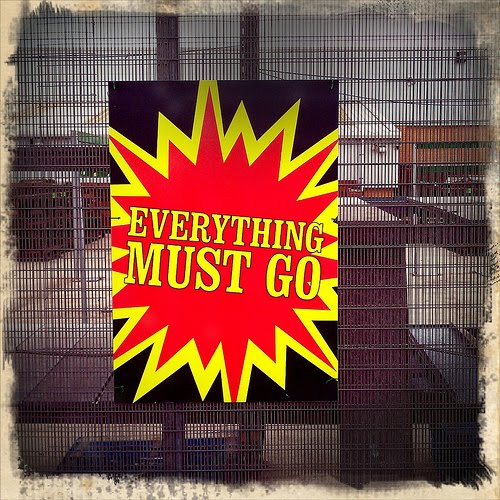 F-Bomb Alert: My mom should not read this post (she will anyway).
My teaching career is officially, finally, and irrevocably over. After 19 years in the biz, I've had enough. A few months ago, a friend of mine said, "You know, there are problems at every job; I just need a different set of problems." And I guess I kind of took her statement into my own heart.
The more I thought about it, the more I realized I, too, need a different set of problems. So I went out of business...mainly because I'm too tired to keep the store open anymore and because I'm not even sure how I went from being a teaching professional to a business owner.
"Delivering composition." It's the title of a well-known book in my former field, and it's the way many in that field refer to their work. Deliver stuff to someone. Like fucking UPS. It's the tabula rasa in make-up and high heels (because those who "deliver composition" are overwhelmingly female). Worse still, while every college and university across the nation considers composition a foundation of their educational program, it is largely taught by contingent faculty...mostly women...who are far too generous with their time in comparison to the pay they receive, which is among the lowest at any university. Darkness visible: importance undervalued.
I didn't actually sign up for a teaching career. Like most things in my life, it fell into my lap. My Pell Grant was suddenly cut off, and I was forced to graduate. I spent a summer wondering, "What the hell?" And then I got a call from a college friend. The Intensive English Program needed a warm body to stand in front of a class of international students. "Could you be that body?" I was desperate, so I took the job. I remember buying cheap "professional" clothes from Wal-Mart after I accepted my offer. They (the clothes, not the offer) were (a) too big and (b) so unfashionable even for the time that, if you tagged me in a picture of myself wearing them on Facebook, I'd have to unfriend and then block you (after untagging myself, of course).
The funny thing is no one in my new department wanted to teach writing. Being the n00b, I eventually became the expert in teaching writing to students for whom English was a second language...through experience and gut instinct...not through any sort of training. Sure, I read some articles, tried some stuff, and eventually disposed of it because it didn't really get at the reality of how people learn to write well.
You know, I've been writing since before I could write. I'd pen stories I spoke out loud as I wrote down chicken scratches that I thought looked something like the alphabet. I'd show them to my mother: "Sansy, you'll learn to write soon enough." She was wrong. In first grade, I was not taught to write. I was taught to copy. I was also taught that variation from the norm is forbidden. This set of rules for behavior was known as "penmanship," and it taught me that words ending in -ship are often not trustworthy: hardship, censorship, partisanship (not a real thing), membership (generally leads to responsibilities one does not want), kinship (backstabbing, in-fighting, general carnage), etc. So I took to my granddad's typewriter (a Remington that celebrated it's 92nd birthday in July) and did my own thing sans a fat pencil, a Big Chief tablet, or a template. (I'm going all Lady Gaga and seeing how many times I can work my own nickname into each post. See?). It also taught me that if you really want to learn to do something, you have to take matters into your own hands. That's how I learned to actually write, and it didn't feel soon enough. Even at that young age, I had something to say, I wanted to say it, and I felt like forces were holding me back.
My mom and I discovered, when I was in high school, that the reason I was never assigned homework is because I actually was. I just didn't understand the concept. The teacher would tell the class to read this and fill out that, so I did it when I was bored and waiting for everyone else to catch up with whatever the teacher was droning on about (which I had already read in the textbook). I thought that was what we were supposed to do...keep busy. I didn't know I was supposed to sit there quietly doing nothing while all that homework piled up for us to take home.
My bad.
At least I had glorious afternoons playing in the weird back yard that was designed by a concrete manufacturer in 1884: a reflection pool, a rock garden, an octagonal fish pond with island and bridge, a six-foot high bird bath, a wisteria arbor. Hell, the man even encircled the clothesline with sidewalk. My house was THE place to be after school. And when everyone got called in for supper and I had finished eating, I went to the typewriter.
One day, in fifth grade, I ran out of homework to not take home. So I wrote a poem about what was going on in the classroom. I observed things I had never noticed before; it made me pay attention (I even made it rhyme, and, yeah, I know, "E Gad!"). I copied it, by hand (I didn't have access to the lovely pasty smell of the ditto machine) and gave it to my teacher as a sort of present. She gave it to the school secretary, and thus I became a published author for the first time...in the school newsletter. Later that year, I was given an assignment to write a biography about someone famous (good grief, why do these subjects withstand the test of time?). I naturally wrote an essay about one of my ancestors, Benjamin Franklin, whom my dad was named after, and I got the highest grade of anyone for that assignment. I was only interested in my subject because my dad had studied Ben's life backwards and forwards, in all its tarnished glory, and had regaled me with the more kid-friendly of our progenitor's exploits. After I had written the paper, I asked my dad to check it. I don't know if he was laughing at my naivete or with joy that he had taught me something. Probably both. At any rate, he kindly and verbally corrected some parts and told me how proud he was of me. Through so many experiences like these, I learned the power of observation and that I was a WRITER.
If you want to write well, here's what you need to know:
- If you want to write, just do it.
- No matter how bad it's going, wait for the moment when it all turns right. It'll happen.
- It doesn't hurt to share. Some will love you; others will rip you apart. Somewhere in the middle is the truth.
- Motivation is key; you need to want something bigger than yourself and your own little world.
- You'll mess up a lot (typewriters are good for reminding you of this).
- Find a way in to every project.
- It isn't cheating if you ask for help.
There, I bubble-wrapped it, put it in a cardboard box filled with Styrofoam peanuts, taped up the box, drove it to your house, knocked on your door, and handed it to you. Delivered.
There are several problems with this metaphor, however. Once something has been delivered, what happens to it?
- What if the customer doesn't like it and wants to return it? (I thought I wanted Product X, but I've changed my mind.)
- What if the customer wants an exchange? (I want a better version of Product X.)
- What if he/she never opens the box (In one week, I'm no longer interested in Product X. In fact, I'm so uninterested by Product X, I won't even take the time to open the box or inquire about a possible return. I'm actually willing to lose money on it by not returning it.)
- What if your consumer only consumes part way and gives up in frustration? (I can't understand the instructions; I'll just leave it in the garage half done.)
- What if the product is a "gift" the consumer didn't want?
- What if the product doesn't meet the customers expectations because they didn't understand the product's description? (Wait, I bought a hardware key logger so I wouldn't lose all my stuff in the event of the Zombie Uprising, and you're telling me I can't use it with a laptop?)
Begin digression. 4 That last one was oddly specific, wasn't it? 3End digression.
There are a number of problems with this metaphor. The first of which is that students are not consumers and teaching does not result in a product. Consumers are people who buy, let's be literal, food and eat it. I don't want the "products" of their consumption landing on my desk. And maybe that's why student writing is so often crappy...because we've adopted the wrong metaphors for understanding what writing actually is and we refuse to see that learning how to do it will be different for every single person. No method is prêt-à-porter. Also, you can't deliver learning and expect anything to happen. You have to create opportunities for people to learn, and the classroom is probably the worst place for opportunity with its hierarchy so obviously laid out in rows.
To make matters worse, if I were still in the delivery business, as a member of the contingent faculty, I would have the additional threat of being drawn and quartered hanging over my already taut nerves. The Four Horses of the Apocalypse who would ensure the failure of my delivery would be as follows:
- My creditor: the person who renews my contract, i.e. my chair.
- My landlord: the state that pays me.
- My competition: the other composition programs out there who drive every program to act according to the same model.
- My customers: the people I'm supposed to serve out of the goodness of my heart.
Let me break it down. My creditor wants me to maintain standards, which means certain grades should form a bell-shaped curve. (The books must be balanced!) My landlord wants me to concentrate on retention which means I should do whatever it takes to make sure students pass my class. (You must pass all regulatory inspections.) My competition wants me to stay within the accepted rules of how we deliver our goods; this doesn't affect me personally, but it certainly dictates the methods by which we assess our program. (We are the standard-setters for this particular business; never mind your unique circumstances. Our guidelines should be met by everyone.) And finally, there are the customers. The people I'm supposed to serve out of love for teaching. And if I could have gotten loose of my restraints, believe me, I would have made my getaway on their horse. Unfortunately, there's already a master holding the bridles, and that master's name is "Lottery College Scholarship."
These students have been told they stand a fighting chance, and they want it. We tell them that writing is about exploration, and they feel invited. And then we slap a grade on their fledgling attempts, and I'm sorry for the mixed metaphor (but, hell, I'm the queen of the mixed metaphor and there are so many in this text already, what's one more?), we expect them to fly?
This model is broken because it pits the teacher against everyone else.
Students want to maintain their scholarships; chairs want a bell-shaped curve. The legislature wants to move the college graduation rate above 18%. I'm not sure standards have ever actually entered the minds of any legislator in this respect. My imaginary elected official thinks something like this: "Give college students the Easy A, damn it! Knowledge-based industries like Google will never figure out how woefully inadequate our workers are until we've attracted them with our tax incentive packages, and then it'll be too late!" Beg your pardon, legislators, the information age is actively looking for brain capital, and they know we don't have it.
In the meantime, the Council of Writing Program Administrators (WPA) sets standards for class size and assessment guidelines that go against anything any administrator in this state has the money to agree to thanks to the legislature that subsidizes every public school of higher education here. This is the very same legislature that decided to award unprepared students scholarships for college with stipulations they can't meet.
And this is why everything must go. And by everything I mean grades, standards, enforced curricula (assignments, textbooks, methods of teaching, especially the tabula rasa model), and the disenfranchisement of women in the discipline.
Oh, and grading 640 papers a semester? That was the first thing I put into the trash.
Photo Credit: Bearfaced via a Creative Commons Attribution-Noncommercial-NoDerivs License. http://www.flickr.com/photos/bearfaced/5845467008/sizes/m/in/photostream/
Wednesday, June 8, 2011
If You're a Masochist in Need of a Fix, Try Writing a Novel
 Yeah, so what...I've been away for a while. I never expected this blog thing to get off the ground anyhow. Yet I still keep writing...in what can only be labeled a masochistic act designed to end in failure.
To whit: I've had a literary novel in my head and on my hard drive yearning for attention now over 10 years.
Too bad.
Because I got an idea for a novel, pure pulp fiction, no less, in a genre I love: the mystery/crime thriller that borders on horror. (I consider I Saw the Devil, a Korean flick, the penultimate film in this particular genre. But trust me, if you're sensitive in mind or stomach, avoid watching it at all costs; you've been warned.) In my opinion and since the novel is writing itself (even as I write this blog thoughts are coming to me left and right), this project should be easy.
Here's the problem: I keep re-reading and revising it and thinking, "This is total crap."
And by "total crap" I don't mean pulp fiction that sells millions of copies, all John Grisham like (a fellow who happens to hail from my home state, BTW). I mean "total crap" as in "I might as well join the Fulker County Writers' Society" (FCWS). (The name has been changed to protect the not so innocent).
Of course, if you're not from around here, you have no idea what the FCWS is all about. So let me clarify: if you write sentimental rhyming poetry, you might be a red...*cough*...a member of the FCWS. (A nod to Jeff Foxworthy for providing the lead in to that lame joke).
So I'm writing this stupid pulp fiction novel and beating myself up because it's not good enough. As far as this kind of writing is concerned, I'm thinking, "Plot and characters are your only concern. Don't sweat the cliches; they're short cuts the typical reader needs." But damn it, I want every sentence to be awesome in the way that my friend Kevin Brockmeier's sentences are awesome.
In other words, I secretly want this thing to be literary. Well, not so secretly anymore.
So I go back to baseball, which I'm pretty sure is the metaphorical cipher of the universe. There will always be minor leagues comprised of those players who want to make it into the big leagues and those who just love the game. So maybe I should just accept that I'm a minor leaguer with a passion for the game and keep on batting because, really, I've got nothing to lose, right?
Thursday, March 24, 2011
I'll Cry [Foul] If I Want To: Etiquette and Social Networking
 I really don't have time for this, so I'll make it short. (Just so you know, I've learned the hard way that if inspiration crawls in your lap, you'd better give it a cuddle before it reverts to its old aloof self and reconvenes on its duty to shred your curtains. And, yes, I live with cats.)
I'm on spring break which means I'm cleaning the house as if I were expecting an international delegation. After this week, I'll have only one and a half months to get caught up on grading and finish teaching classes in addition to observing tutors and pre-tutors in the Writing Center. Not a lot of time in the scheme of things, so the house must finally, irrevocably, be in order. I've been rewarding myself for getting things done by peeking at Facebook now and then.
The other night I checked out an exchange between two mutual friends, part of a group that hangs out together, as in face-to-face, fairly frequently. There's a reason: we share the same values, political stance, and profession. We're the loathsome liberals everyone should fear, so naturally, we get along well. Somewhere near the end of the conversation I was following between these two friends, someone I don't know posted a statement I all too immediately recognized as Tea Party drivel, part of their tactics to ensure their voice is heard over all others so that it seems they represent the majority (Look it up on Wikipedia.com, if you don't believe me, or go to one of their sites, if you don't believe Wikipedia. They openly admit it.)
-->Begin slight digression. I get a bit irritated by people who hijack my Facebook wall, no matter the reason. I've had people plan get-togethers I couldn't attend on my wall: "Uh, hello, ever heard of wall-to-wall or e-mail? Because if I can't come, I probably don't want to hear about the fun y'all are going to have without me." I've had friends who fundamentally agree get into arguments over miniscule semantic problems: "Please stop, you're making me sad." I've had others take the topic of conversation into wholly other universes without so much as employing the old Monty Python segue, "And now for something completely different..." with a vaudevillian swing of the elbows from side-to-side. In these cases, I want to ask, "How about posting that on your own status updates? Because you do have your own, you know that, right?"<--End slight digression. But this situation seemed like a hijacking of much more momentous proportions to me, so I commented, "This is what the 'hide,' 'unfriend,' and 'block' features on Facebook are all about." Oh, and I might have said something about censorship being the right of the person who has to read a bunch of crap they don't agree with. (Okay, I was acting a bit of a provocateur myself. I know, you're thinking, "What, Sans? No. Never.") Anyhoo, the Tea Partier then tried to provoke me with some statement along the lines of "You're going to shut me down just because I say something you disagree with instead of engaging me in public debate." Well, he isn't my friend, so I couldn't shut him down. I could, however, ignore him, which is what I did, turning off my computer and turning in for the night. I woke the next day thinking about what had transpired and why this hijack perturbed me more than others I had witnessed (besides the fact the perpetrator was obviously a Tea Party troll).
Not to confuse metaphors, but my Facebook wall is my party--as in a social gathering at my house--not as in a political affiliation. I may have invited you to it; more likely you invited yourself (because I don't often friend people), and I agreed to let you attend. That does not give you the right to get shit-faced drunk, become obnoxious, spill your drink all over my antique furniture (in the form of your political invective), and insult my other friends. If you do that, guess what? I'll ask you to leave because my party is NOT your public forum.
As a matter of fact, I find this whole idea of "just engaging in public debate" disingenuous. When people say that what they really mean is "Here, come closer so I can beat you over the head with my opinion, which I stupidly believe will end in your total agreement with everything I say because my rhetorical prowess is just that good." Uh, no, actually, it isn't. And, besides, we all know I'll agree with you when pigs sprout wings and start offering private international flights at incredibly reduced rates.
The only way this is really going to end is with the cops being called. So why bother going there? If you disagree with something someone says at my, or anyone else's party, why not try to be polite to your host and avoid getting embroiled in a pointless argument that's just going to spoil the mood and break the party up?
If you want to "engage in public debate" either run for office or have a party at your house, on your wall, and I promise I won't attend.
BTW, all comments are moderated because it's my party and I'll moderate it if I want to.
Photo courtesy GarryKnight via Flickr
Subscribe to:
Posts (Atom)